The questions we should have asked in 2022
Guest Post by Jacqui Finn
Jacqui Finn is Katy's creative partner at Bravance Learning and the technology coordinator at The Accord School.
Katy asked me to write to you about AI. Fair warning: most of what I have to say about AI is really about people.
It has been a loud few weeks. Researchers have been leaving the major AI labs with public warnings about the industry racing ahead of its own safety work, and Scientific American reported that one of them was backed up by a colleague still inside the company, who put the chance of AI causing human extinction within the decade above one in ten. Tens of thousands of scientists and public figures have signed a Future of Life Institute statement asking the industry to hold off on building superintelligence until it can be done safely and with public consent. The coverage has been grim, and if you have been reading it with a knot in your stomach, you are in good company.
None of it is the whole story. Slowing down, building guardrails, and getting literate about these tools are all choices, and the third one is yours to make this week.
The unease is widespread and reasonable. Pew Research Center found this summer that just over half of U.S. adults say AI makes them more concerned than excited, up from 37% five years ago. For school leaders, counselors, therapists, and teachers, this lands on top of an already full plate.
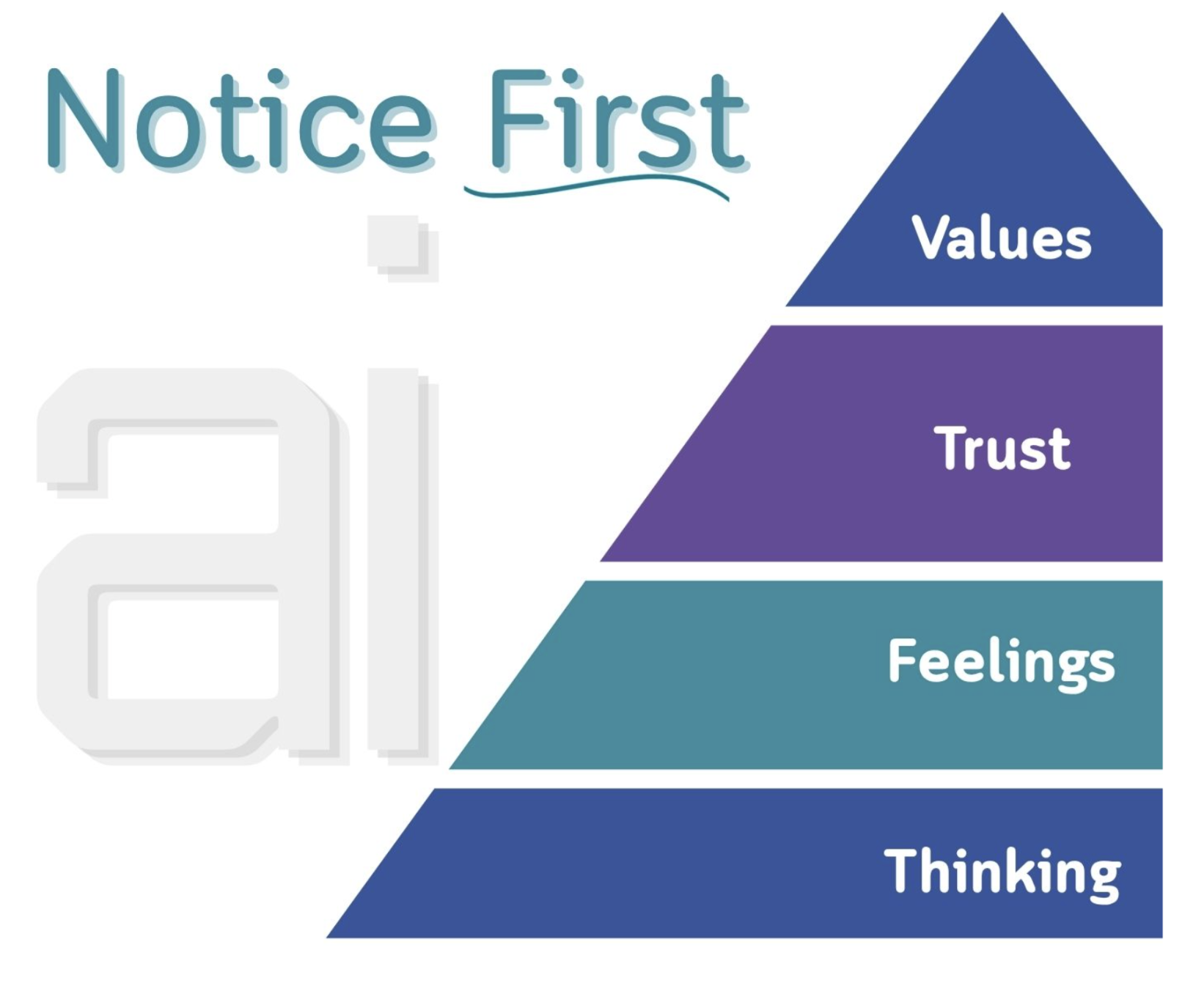
Notice First is built to change where the figuring starts.
When this technology reached classrooms in 2022 and 2023, the conversation jumped straight to tools. Which app, which prompt, which policy. The step nearly everyone skipped was the professional one: deciding what you actually want from the thing before you use it.
That decision has four parts, and the course takes them one at a time.
Thinking. How you think, what kinds of thinking you are strong in, and which ones you may be handing over without meaning to.
Feelings. Your emotional state is information. What you bring into an AI interaction shapes what you accept coming back out of it.
Trust. Trust calibrates task by task, built on evidence you gather yourself rather than on awe or on fear.
Values. Capability is not permission. What a tool can do is a fact about the tool. What you use it for is a decision about you.
By the last lesson, all four fit on a single card and take about twenty seconds to run.
Notice First is free through October 15. This is a strange and unsettling stretch for everyone working with young people, and opening the course felt like the right response to it. Come take a look!
Start Notice First, free through October 1
Sources
Future of Life Institute. (2025, October 22). Statement on superintelligence. https://superintelligence-statement.org/
Hall, P. (2026, September 11). AI researcher Jacob Coxon quit, fearing extinction. Security experts see a familiar fight. Scientific American. https://www.scientificamerican.com/article/ai-jacob-coxon-quit-extinction-fears-security-experts-see-familiar-fight/
Pew Research Center. (2026, August 18). Young adults in the U.S. are increasingly wary of AI, concerned it will take jobs. https://www.pewresearch.org/short-reads/2026/08/18/young-adults-in-the-us-are-increasingly-wary-of-ai-concerned-it-will-take-jobs/